Fatty liver has a new name — and a screening pathway you can start from a routine blood panel
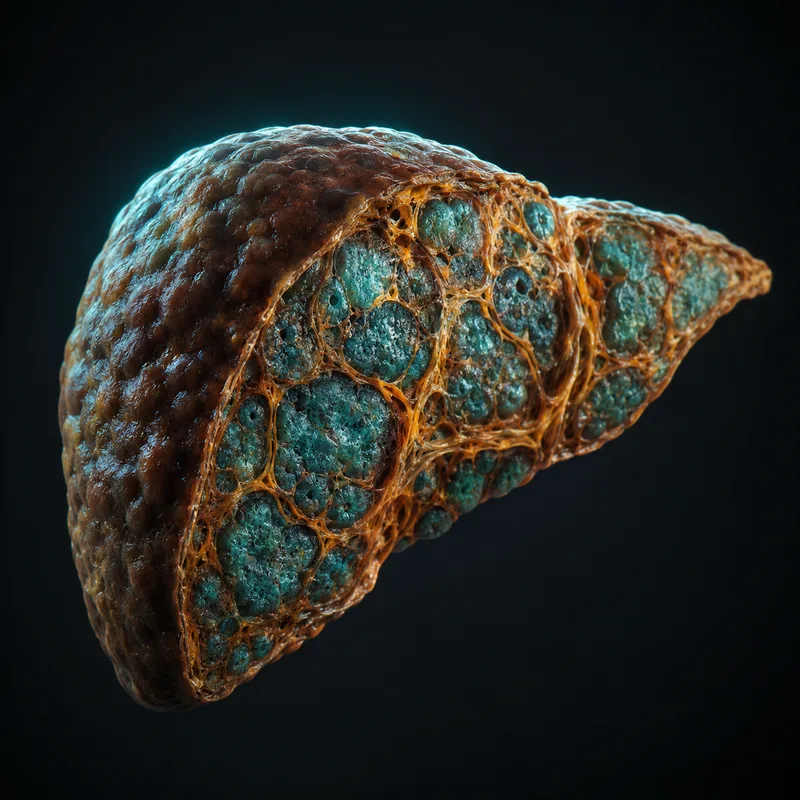
A third of adults have it, most never hear about it, and the test that finds the dangerous cases is already sitting in a standard blood panel.
In short
- NAFLD became MASLD in 2023, and the change is not cosmetic: diagnosis now requires at least one cardiometabolic risk factor rather than the exclusion of alcohol.
- Roughly a third of adults worldwide have MASLD — it is the most common liver condition, and most of them do not know.
- What matters for prognosis is not fat in the liver but fibrosis. The 2024 guidelines name FIB-4 the first-line test, calculated from age, AST, ALT and platelets.
- FIB-4 below 1.3 makes advanced fibrosis unlikely; above 2.67 warrants specialist assessment. From age 65 the lower cutoff rises to 2.0, otherwise the score over-flags healthy people.
- The score is a filter, not a diagnosis — and it is least reliable in the people most likely to be screened: those with obesity and type 2 diabetes.
Introduction
For twenty years the condition was called NAFLD — non-alcoholic fatty liver disease. In 2023 a panel of 236 experts from 56 countries replaced that name with MASLD: metabolic dysfunction-associated steatotic liver disease.
This was not a branding exercise. The old name defined the disease by what it was not — not alcohol — which meant diagnosis by exclusion, and it embedded two words that most patients and clinicians found stigmatising. In the consensus survey, 61% considered "non-alcoholic" stigmatising and 66% said the same of "fatty".
The substantive change is in the definition. MASLD requires steatosis plus at least one of five cardiometabolic risk factors — raised BMI or waist circumference, raised glucose or diagnosed diabetes, raised blood pressure, raised triglycerides, or low HDL. The condition is now defined by what it is: a liver manifestation of metabolic dysfunction. If you want the underlying concept first, our glossary entry on fatty liver covers the basics in plain terms.
How common it is, and why almost nobody is told
A 2025 meta-analysis of studies published between January 2023 and August 2024 put the global prevalence of steatotic liver disease at 37.5% (95% CI 31.4–44.1), with MASLD as the dominant subtype at 33.6% (95% CI 28.1–39.5).
A third of the adult population. That is not a rare finding — it is closer to a baseline.
The reason it stays invisible is that early MASLD produces no symptoms and often no abnormal labs. Liver enzymes can sit in range with substantial steatosis present; ALT is neither sensitive nor specific enough to be used as a screen. Ultrasound picks up fat but says nothing useful about the thing that actually matters.
And here is the part worth internalising: fat in the liver is not the problem. Scarring is. Steatosis on its own carries a modest outlook. What predicts liver-related death, cardiovascular events and overall mortality is the stage of liver fibrosis — which is why the entire screening logic is built around finding fibrosis, not fat.
FIB-4: four numbers you probably already have
The 2024 EASL–EASD–EASO guidelines and the first AASLD guidelines on non-invasive liver disease assessment converge on the same first step: use a simple, non-proprietary blood-based score first, and FIB-4 is the named example.
Its appeal is that it needs nothing new. The formula uses age × AST ÷ (platelets × √ALT) — so AST, ALT and platelets from any standard panel, plus your age. No extra draw, no proprietary assay, no cost.
The thresholds work as a two-sided filter:
- Below 1.3 — advanced fibrosis is unlikely. This is where the score is strongest: a high negative predictive value is exactly what a screening test needs.
- 1.3 to 2.67 — indeterminate. Not reassurance, not alarm; it means the blood score cannot settle the question and a second-line test is needed.
- Above 2.67 — advanced fibrosis is likely enough to warrant specialist assessment.
One adjustment matters and is often missed. From age 65 the lower cutoff rises from 1.3 to 2.0. FIB-4 contains age in the numerator, so it drifts upward with age on its own; applying the adult cutoff to older people generates a flood of false positives. Our FIB-4 calculator applies the age-adjusted threshold automatically.
The guidelines describe a stepwise pathway: blood score first, then imaging — typically transient elastography — for anyone who lands in the indeterminate or high band. The score decides who needs the scan, not what the diagnosis is.
Where FIB-4 stops being reliable
A screening test used outside its limits produces confident nonsense, so it is worth being explicit about them.
Obesity and type 2 diabetes. A 2025 review in Clinical Gastroenterology and Hepatology is direct about it: accuracy is limited precisely in patients with obesity and diabetes. That is an uncomfortable finding, because those are the people most likely to be screened in the first place. In this group a normal FIB-4 is weaker reassurance than the number suggests.
Anything that moves platelets or AST for other reasons. The formula does not know why a value changed. Immune thrombocytopenia, alcohol, a recent viral illness, intense exercise before the draw, or muscle injury will all shift the result without any change in the liver.
Age under 35. The score was validated in middle-aged cohorts and behaves poorly at the young end; a raised value in a 28-year-old warrants a different line of thinking rather than a fibrosis label.
Tracking change over time. The 2024 AASLD guidelines explicitly decline to recommend non-invasive tests — blood or imaging — for monitoring progression or regression, citing insufficient evidence. So a FIB-4 that moved from 1.1 to 1.4 between two visits should not be read as "my fibrosis is progressing". It is within the noise of the inputs.
Alcohol deserves its own line. MASLD no longer requires excluding alcohol, but alcohol has not stopped mattering — significant intake alongside metabolic risk is now classified separately, and the distinction changes management. Our entry on alcoholic liver disease covers where the boundary sits.
What actually changes the trajectory
The most consistent finding across the guidelines is unglamorous: weight reduction is the intervention with the strongest evidence, and the effect is dose-dependent. Modest loss improves steatosis; larger sustained loss is required before steatohepatitis and fibrosis respond.
Because MASLD is defined by metabolic dysfunction, the levers are the metabolic ones — insulin resistance, visceral fat, blood pressure, triglycerides. This is also why the cardiovascular framing matters: people with MASLD are more likely to die of cardiovascular disease than of liver disease. Treating it as "a liver problem" underestimates it.
Two practical checks worth doing alongside FIB-4: the metabolic syndrome assessment, since meeting the MASLD definition requires at least one of those same criteria, and METS-IR as an insulin-resistance estimate that needs no fasting insulin.
A closing caution on the numbers. These scores were built to sort populations into risk groups, not to diagnose an individual. A result outside the reassuring band is a reason to bring the panel to a clinician — not a diagnosis, and not something to manage from a calculator.
What to do
- Find AST, ALT and platelets on your last panel and run FIB-4. No new test is needed, and the result tells you whether anything further is warranted.
- Read the result against your age. Under 65 the reassuring band is below 1.3; from 65 it is below 2.0. Using the wrong cutoff is the most common error with this score.
- Treat an indeterminate result as 'not answered', not 'probably fine'. The 1.3–2.67 band is exactly the group the guidelines send for elastography.
- Check the metabolic side too. MASLD requires at least one cardiometabolic criterion, so waist circumference, glucose, blood pressure and triglycerides are part of the same picture.
- Do not track fibrosis by repeating the score. Current guidelines do not support non-invasive tests for monitoring progression; small movements between visits are noise.
Related material on the portal
More from the blog
FAQ
Is MASLD just NAFLD with a new label?
Mostly the same patients, but the definition genuinely changed. NAFLD was a diagnosis of exclusion — fat in the liver with alcohol ruled out. MASLD requires steatosis plus at least one of five cardiometabolic criteria. In practice the overlap is high, but the new definition identifies the condition by its metabolic cause rather than by what it is not.
My liver enzymes are normal. Can I still have MASLD?
Yes, and this is common. ALT and AST can sit within the reference range with significant steatosis and even with fibrosis present. Normal enzymes are not a rule-out, which is exactly why the guidelines build screening around a composite score and imaging rather than around enzymes alone.
My FIB-4 came out in the middle band. What does that mean?
It means the blood score could not answer the question — not that the answer is probably fine. The 1.3–2.67 range is indeterminate, and current guidelines route this group to a second-line test, usually transient elastography. Discuss it with a clinician rather than repeating the score.
Should I repeat FIB-4 every few months to watch the trend?
The 2024 AASLD guidelines specifically do not recommend non-invasive tests for monitoring progression or regression, because the evidence is not there. Platelets and AST move for many reasons unrelated to the liver, so small changes between visits mostly reflect input variability.
Does the new name mean alcohol no longer matters?
No. MASLD removed alcohol exclusion from the diagnostic criteria, but significant alcohol intake alongside metabolic risk factors is now a separate category, and that distinction affects management. Alcohol and metabolic dysfunction damage the liver through overlapping routes, and having both is worse than either.